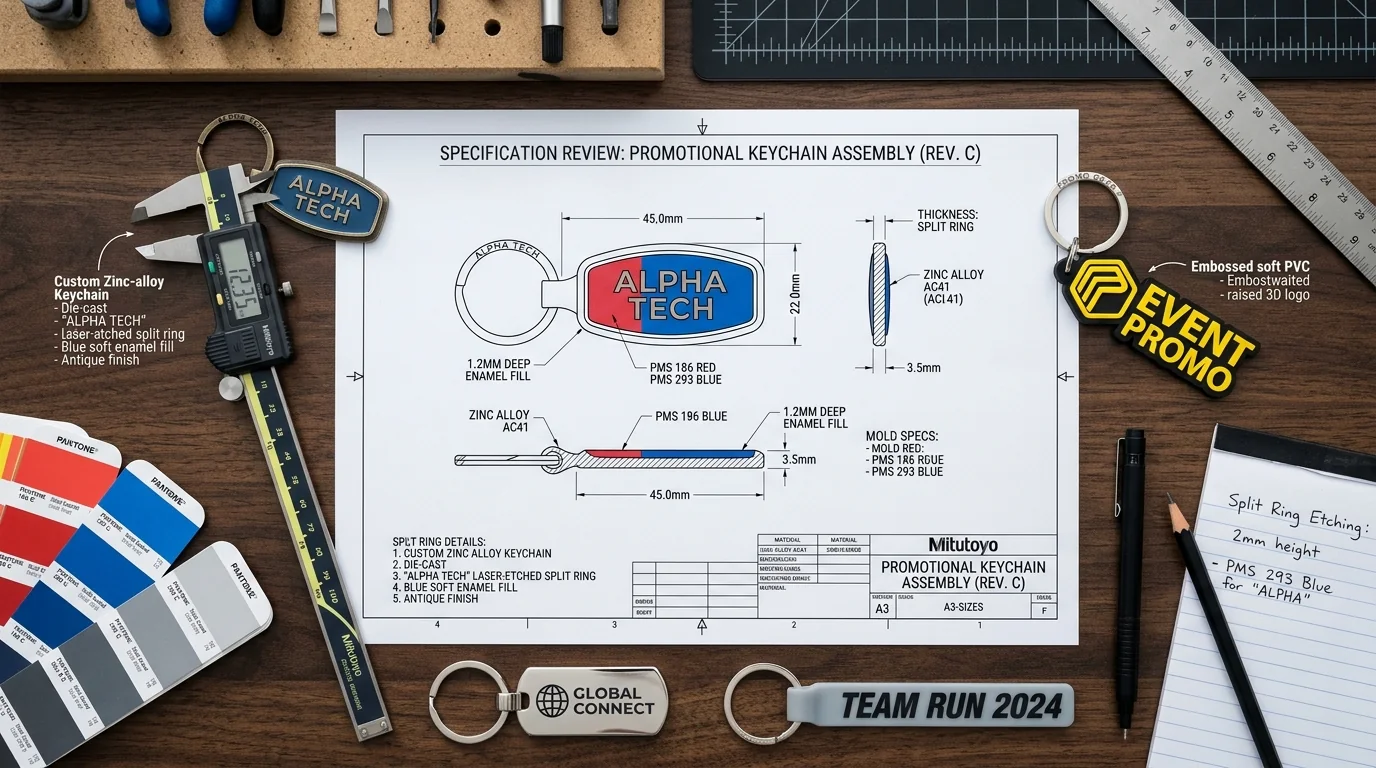
Figure 1.0: Vector line thickness verification, 3D relief mold depth calibration, and Pantone solid coated enamel color checks at Naike Gifts tooling center.
A complete custom keychain brief eliminates 90% of mold re-work and sampling delays. Professional buyers must define five core engineering parameters before mold opening:
- Material Specification: Die-cast #3 Zamak Zinc Alloy for 3D contoured shapes; stamped brass or iron for flat geometric soft enamel; or food-grade silicone/PVC for flexible retail designs.
- Dimensional Tolerances: Standard thickness: 2.5mm–3.5mm. Minimum metal line width: 0.3mm; minimum enamel color fill well: 0.4mm.
- Electroplating & Finish: Shiny nickel, antique bronze, imitation gold, or matte black electrophoresis, sealed with anti-oxidation clear lacquer.
- Corrosion Resistance: Minimum 24–48 hour neutral salt spray (NSS) test compliance under ASTM B117.
📌 Compliance Reference: Finished metal keychains exported to the US and EU must comply with CPSIA Total Lead (<90 ppm in coatings, <100 ppm in substrate) and EU REACH Annex XVII entry 27 (Nickel release <0.5 µg/cm²/week).
Keychains are among the highest-volume promotional merchandise categories worldwide, but incomplete project briefs frequently result in illegible micro-text, zinc porosity, or rapid plating oxidation. Below is our manufacturing plant's technical blueprint to ensure first-time sampling approval.
Material Selection: Zinc Alloy vs Stamped Brass vs Soft PVC
Selecting the right substrate determines mold tooling structure, unit cost, and consumer hand-feel:
| Substrate Material | Manufacturing Process | 3D Sculpting Detail | Weight & Handfeel | Tooling Lead Time | Piece Cost Index |
|---|---|---|---|---|---|
| #3 Zamak Zinc Alloy | High-Pressure Die Casting | Exceptional (Full 3D relief & cut-outs) | Substantial & Heavy (7.1 g/cm³) | 5–7 Days | $$ (Benchmark) |
| Stamped Brass / Bronze | Hydraulic Stamping / Coining | Moderate (2D or 2.5D levels) | Premium & Dense (8.5 g/cm³) | 7–10 Days | $$$$ (2.2x vs Zinc) |
| Stamped Iron | Die-Struck Compression | Basic (Flat 2D lines) | Solid (7.8 g/cm³) | 5–7 Days | $ (0.75x Budget) |
| Eco Soft PVC / Silicone | Multi-Color Liquid Dispensing | High (Soft 3D layers, tactile) | Light & Flexible (1.3 g/cm³) | 4–6 Days | $ (0.8x Promo) |
Engineering Artwork and Tolerance Guidelines
To avoid molten metal mis-runs or enamel color bleeding during factory production, artwork files must satisfy these minimum physical design rules:
- Minimum Raised Metal Ridge Width: Must be at least 0.30mm (0.012"). Finer lines cannot be reliably CNC-milled into mold cavities without premature tooling wear.
- Minimum Enamel Color Fill Reservoir: Must be at least 0.40mm (0.016") in diameter. Liquid enamel dispensing needles require adequate surface tension to fill color wells cleanly.
- Standard Thickness by Size: For keychains under 40mm, specify 2.5mm thickness; for items 45mm–60mm, specify 3.0mm–3.5mm to prevent mechanical bending under daily pocket stress.
- Cut-Out Holes (Pierce Tooling): Internal negative space voids require a minimum hole diameter of 1.5mm to accommodate ejector pin clearance.
Common Industry Misconceptions Debunked
❌ Myth 1: "Any Vector Logo Can Be Directly Cut into a Metal Mold"
✔ Engineering Reality: Digital vector files frequently contain sub-0.1mm hairline strokes and gradients. In metal die casting, colors must be physically separated by raised metal boundaries. Our pre-production DFM engineers must create an engineered "metal mold proof" that thickens hair lines and maps RGB/CMYK gradients into distinct Pantone Solid Coated wells.
❌ Myth 2: "All Shiny Silver Keychains are Made of Stainless Steel"
✔ Engineering Reality: Over 90% of retail keychains are die-cast from Zamak zinc alloy and finished with electroplated nickel or chrome. Stainless steel is extremely difficult and expensive to die-cast into intricate 3D shapes due to its 1450°C melting point (vs 385°C for zinc).
❌ Myth 3: "Electroplated Plating Will Inevitably Rub Off After 2 Weeks"
✔ Engineering Reality: Plating wear occurs only when factories skip copper barrier underplating or omit clear electrophoretic baking lacquer. At Naike Gifts, all metal parts receive triple-layer electroplating (Copper base > Nickel barrier > Final finish) plus high-temp baked sealant, passing 48-hour ASTM B117 salt spray tests.
Plating Finishes and Durability Testing Standards
Keychains live in pockets alongside abrasive keys, coins, and moisture. Our factory implements two primary quality assurance gates:
- 48-Hour Neutral Salt Spray (ASTM B117): Exposed to a 5% NaCl aerosol fog at 35°C for 48 continuous hours. Zero green copper oxidation or surface blister pitting allowed.
- Cross-Hatch Adhesion Test (ASTM D3359): Performed across enamel fills and printed details with 3M 600 pressure-sensitive tape. 100% adhesion retention required.
- Lead & Heavy Metals Screening: Handheld XRF spectrometry ensures total lead <90 ppm and cadmium <100 ppm, fully compliant with US CPSIA and EU RoHS directives.
B2B Buyer Sourcing & Project Brief Checklist
Key Parameters to Include in Your RFQ
- 1. Vector Artwork: .AI or .EPS format with all text converted to curves/outlines.
- 2. Color Specification: Specify Pantone Solid Coated (PMS C) codes for all colored enamels.
- 3. Plating Finish: Choose between Shiny Nickel, Antique Brass, Rose Gold, Matte Black, or Rainbow Anodized.
- 4. Attachment Type: Specify standard flat split ring (25mm or 30mm), swivel lobster claw clasp, or cable ring.
- 5. Packaging Presentation: Polybag bulk, custom printed 350gsm backing card, or matte black magnetic presentation box.
Need a Free DFM Artwork Review or Mold Quote?
Send us your logo artwork. Our Jinjiang metal tooling team provides factory-direct 2D/3D engineering proofs and quotations within 24 hours.
Frequently Asked Questions
What file format is required to open a custom keychain mold?
Vector files (.AI, .EPS, or .PDF) with all fonts outlined are required for 2D designs. For 3D relief or contoured sculpts, native CAD models (.STEP, .IGES, or .OBJ) ensure accurate CNC tooling cavity engraving.
What is the difference between hard enamel and soft enamel?
Soft enamel features recessed color fills below raised metal boundary lines, leaving a tactile textured surface. Hard enamel is baked at 800°C and polished completely flush with the metal lines, producing a flat, jewelry-grade scratch-resistant finish.
How do you prevent custom metal keychains from tarnishing or rusting?
We utilize virgin #3 Zamak zinc alloy die-casting followed by multi-stage copper-nickel-chrome electroplating and a baked electrophoretic clear lacquer coat, passing 48-hour neutral salt spray (ASTM B117) corrosion tests.