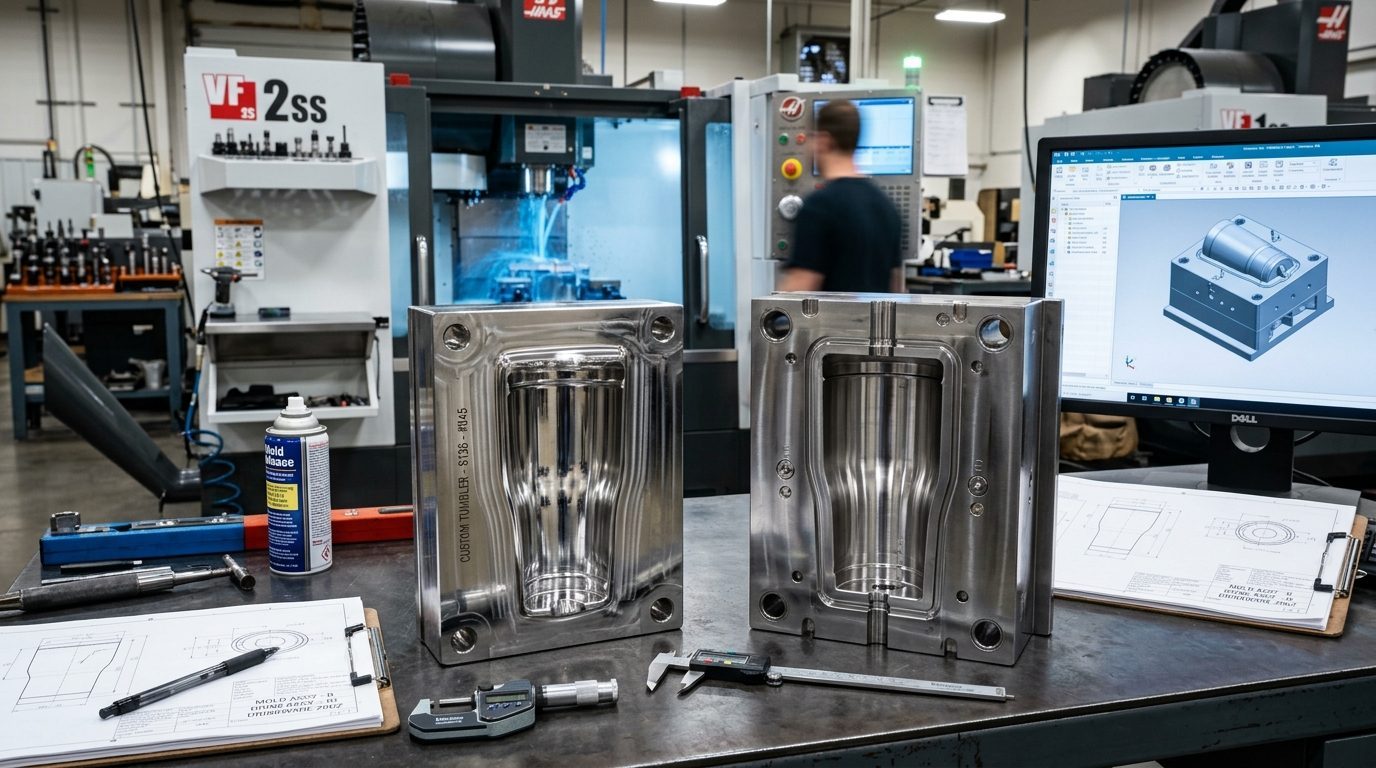
Figure 1.0: S136 hardened stainless steel mold core and cavity inserts undergoing CMM dimensional verification prior to production trials.
The total tooling investment for custom plastic drinkware depends primarily on the number of individual components, cavity count, and tool steel grade:
- Cup Body Mold (Single Cavity): $2,500 – $4,200. Engineered with S136 hardened stainless steel (HRC 48–52), guaranteed for 500,000+ injection shots.
- Complex Multi-Piece Set (Body + Lid + Straw + Seal): $6,800 – $14,500. Involves 3 to 4 distinct steel molds with sliders, thread unscrewing cores, and precision silicone compression tooling.
- Tooling Schedule: Standard lead time is 7 to 15 business days from 3D CAD sign-off to first T1 physical trial shot.
- Amortization Economics: Across an annual order volume of 20,000 units, a $6,000 mold amortizes to just $0.30 per cup—unlocking fully proprietary shapes, patent protection, and zero marketplace competition.
For global brand owners and retail buyers, investing in bespoke injection molds provides the ultimate competitive moat: exclusive ergonomics, proprietary lid mechanics, and distinct aesthetic silhouettes that cannot be copied from generic catalog wholesalers. Below is our transparent line-item breakdown of where tooling capital is deployed.
Line-Item Tooling Cost Breakdown (Typical 20oz Travel Tumbler)
This table breaks down the engineering, metallurgical, and machining expenses involved in manufacturing an export-grade drinkware mold:
| Component / Phase | Engineering Scope | Material / Machine Spec | Typical Cost (USD) | Lead Time Contribution |
|---|---|---|---|---|
| 1. DFM & Moldflow Engineering | Draft angle optimization, gate location, shrinkage compensation, cooling line layout | AutoCAD, SolidWorks, Moldflow simulation software | $300 – $500 | 2 Business Days |
| 2. Standard Mold Base (Bolster) | LKM standardized steel plates, guide pins, ejector return pins, water manifolds | Forged #45 or #50 medium carbon steel | $600 – $900 | 2 – 3 Days |
| 3. Cavity & Core Insert Steel | High-wear, corrosion-resistant inserts contacting molten food-safe resins | Swedish Assab S136 / Daido NAK80 hardened stainless steel (HRC 48–52) | $1,200 – $1,900 | 3 – 4 Days |
| 4. Precision CNC Machining & EDM | High-speed milling (18,000 RPM) of complex contours, mirror spark EDM for threads and logos | 3-Axis & 5-Axis CNC Centers, Sodick Slow-Wire EDM (±0.005mm tolerance) | $1,100 – $1,800 | 4 – 5 Days |
| 5. Polishing & Texturing | Optical SPI A1 diamond hand-lapping for mirror glass clarity or VDI spark etching | Diamond compound pastes (Grade 6μm down to 1μm) | $400 – $700 | 2 Days |
| 6. Assembly & T1 Trial Testing | Tool fitting, slider timing checks, T1 test shots on 250T press, CMM dimensional report | Haitian Servo Injection Press, CMM coordinate measuring machine | $300 – $500 | 1 – 2 Days |
| Total Single-Body Mold | Complete Production-Ready Tooling | Hardened S136 (500k+ Shot Life) | $3,900 – $6,300 | 7 – 15 Business Days |
Key Drivers that Influence Mold Pricing
1. Hardened S136 vs. Pre-Hardened NAK80 Steel
For crystal-clear Tritan and AS drinkware, mold steel selection is paramount. We specify Swedish Assab S136 stainless tool steel vacuum-heat-treated to HRC 48–52. S136 resists rust from condensate cooling channels and takes an SPI A1 mirror finish without orange-peel defects. For opaque PP lunchboxes or fast promotional items, pre-hardened NAK80 steel reduces tooling costs by 15–20%.
2. Single-Cavity vs. Multi-Cavity ROI Economics
A single-cavity mold yields 1 finished part per cycle (e.g., 28 seconds). A 2-cavity or 4-cavity mold doubles or quadruples output per hour, cutting unit labor and machine run costs dramatically.
- Order Volume < 20,000 pcs: Single-cavity tooling is mathematically optimal to minimize upfront capital risk.
- Order Volume > 50,000 pcs: 2-cavity or 4-cavity tooling reduces piece cost by $0.15–$0.35 per unit, paying back the higher tooling investment within the first container order.
Hot Runner vs. Cold Runner Tooling Economics (500k Unit Production Analysis)
One of the most consequential engineering decisions during mold quotation is runner gating architecture. While cold runner molds feature lower initial tooling invoices, hot runner systems dramatically reduce per-unit piece prices on mid-to-high volume production runs.
| Engineering Parameter | Cold Runner System (Three-Plate) | Valve-Gate Hot Runner (Yudo / Mold-Master) | Commercial Impact for Buyer |
|---|---|---|---|
| Initial Tooling Investment | $3,800 – $5,500 (Base cost) | $7,500 – $11,000 (Includes manifold, heaters, PID controllers) | Hot runner costs ~$3,500–$5,500 more upfront during mold fabrication. |
| Sprue & Runner Scrap Waste | 12% – 18% of total shot weight is discarded or reground. | 0% runner scrap. Direct valve-gated injection into the cup cavity. | Saves 12–18% of raw resin cost per cycle (crucial when using $4.80/kg Tritan). |
| Injection Cycle Time | 26 – 32 seconds (Limited by thick runner cooling time). | 17 – 21 seconds (Direct part cooling without runner delay). | Reduces machine cycle time by ~30%, lowering per-unit production labor cost. |
| Gate Mark Visual Quality | Visible sprue cutoff vestige (0.8–1.5mm), requires manual trimming. | Pin-point cosmetic valve gate vestige (<0.2mm), virtually invisible to consumer. | Significantly higher retail shelf appeal for luxury gift packaging. |
| Break-Even Production Volume | Economical for batches ≤ 50,000 units. | ROI break-even achieved at 38,000 units; pure profit savings thereafter. | For runs of 100k+ units, hot runner saves $6,000–$14,000 in total procurement spend. |
Cooling Channel Engineering: How Conformal Cooling Drops Cycle Times by 28%
In plastic injection molding, cooling time represents 65% to 75% of the total cycle time. Traditional straight-drilled cooling channels cannot reach deep cup bases and tapered inner cores evenly, leading to hot spots, differential shrinkage, and post-demolding warpage.
Naike Gifts Tooling Optimization Protocols:
- Beryllium Copper (BeCu) Core Inserts: High thermal conductivity inserts (300 W/m·K compared to steel's 30 W/m·K) placed at the base of tall tumblers to accelerate heat dissipation, cutting 6 seconds off mold dwell times.
- Conformal 3D-Printed Stainless Steel Cooling Cores: For complex dual-chamber drinkware shapes, cooling water lines curve harmoniously with the product contour (1.5mm distance from cavity wall), eliminating hot zones.
- Moldflow® CAE Simulation Validation: Prior to steel cutting, our tooling division runs full gate location, air trap, weld line, and volumetric shrinkage simulations to guarantee first-shot dimensional accuracy (±0.05mm).
Mold Amortization & 100% Refundable Tooling Agreements
Transparent Tooling Ownership Terms: At Naike Gifts, clients maintain 100% intellectual property (IP) and physical ownership of all custom injection molds. We sign strict bilingual Non-Disclosure Agreements (NDAs) guaranteeing your mold will never be photographed, exhibited, or utilized for unauthorized buyers.
Volume Amortization Rebate Schedule:
- Initial Tooling Payment: 50% deposit upon DFM approval, 50% upon golden sample sign-off (T1/T2).
- Per-Unit Tooling Rebate: On subsequent production orders, Naike Gifts provides a $0.05 – $0.15 per unit rebate credited directly against future invoices.
- Full Tooling Refund: When cumulative purchase volume reaches agreed contract thresholds (typically 50,000 to 100,000 units depending on mold complexity), 100% of the initial mold cost is refunded in full.
- Lifetime Maintenance Guarantee: Naike Gifts covers all mold polishing, slider replacement, ejector pin maintenance, and preventive refurbishment free of charge for up to 500,000 shots.
When Can You Avoid New Mold Costs Entirely?
- Custom Pantone Color Compounding: We match any exact Pantone PMS body and lid color on existing in-house molds with $0 mold fee.
- Modular Lid Swapping: Pair an existing bottle body with different off-the-shelf lids (straw lid, chug cap, flip-top shaker, silicone carry handle).
- 360° Silk-Screen & UV Printing: Create entirely unique brand artwork, iridescent coatings, and soft-touch rubberized finishes on proven tooling.
Common Tooling & Mold Misconceptions Debunked
❌ Myth 1: "Aluminum Prototype Tooling Saves 70% Cost Without Any Drawbacks"
✔ Engineering Reality: Aluminum tools suffer thermal fatigue and dimensional creep after just 2,000–5,000 shots. For engineering resins like Tritan and PP that require high injection pressures (>120 MPa) and hot molds, aluminum tools frequently warp. S136 or NAK80 hardened steel tooling amortizes to a lower cost-per-part on any run exceeding 10,000 units.
❌ Myth 2: "More Mold Cavities (e.g. 16 vs 4) Always Cuts Piece Price in Half"
✔ Engineering Reality: Higher cavitation increases required injection clamp tonnage (raising machine hourly rates), increases runner scrap weight by up to 25%, and introduces flow imbalance risks. For drinkware with tight volumetric tolerances, a precision 4-cavity hot runner mold often delivers higher yields and lower net piece costs.
❌ Myth 3: "Tooling Ownership Remains with the Factory After Production"
✔ Engineering Reality: At Naike Gifts, clients maintain 100% legal ownership of custom mold steel. Tooling contracts include serial-numbered mold plates, dedicated mold maintenance logs, and guarantees that molds will never be used for third-party production.
Have a Concept Sketch or 3D CAD Ready for Feasibility?
Send your drawings under a signed NDA. Our tooling engineers will return a 48-hour DFM feasibility report and exact tooling quotation.
Frequently Asked Questions on Drinkware Tooling
Do I need complete 3D STEP/IGES engineering files to start?
No. Even an initial hand-drawn sketch or reference sample is sufficient. Our in-house engineering team provides complete 3D industrial modeling and DFM moldflow optimization before steel cutting begins.
What happens if the first T1 trial sample does not match my approved design?
Naike Gifts guarantees tool dimensions to ±0.02mm. If T1 samples deviate from your approved 3D CAD drawings, all mold revisions, re-machining, and T2 sample air shipments are executed at 100% our expense.
How long does a mold last, and who pays for maintenance?
Our S136 steel tools are rated for 500,000 to 1,000,000 shots. We provide lifetime preventive mold maintenance (cavity de-greasing, ultrasonic cleaning, ejector pin lubrication, and climate-controlled storage) at zero cost to the client.