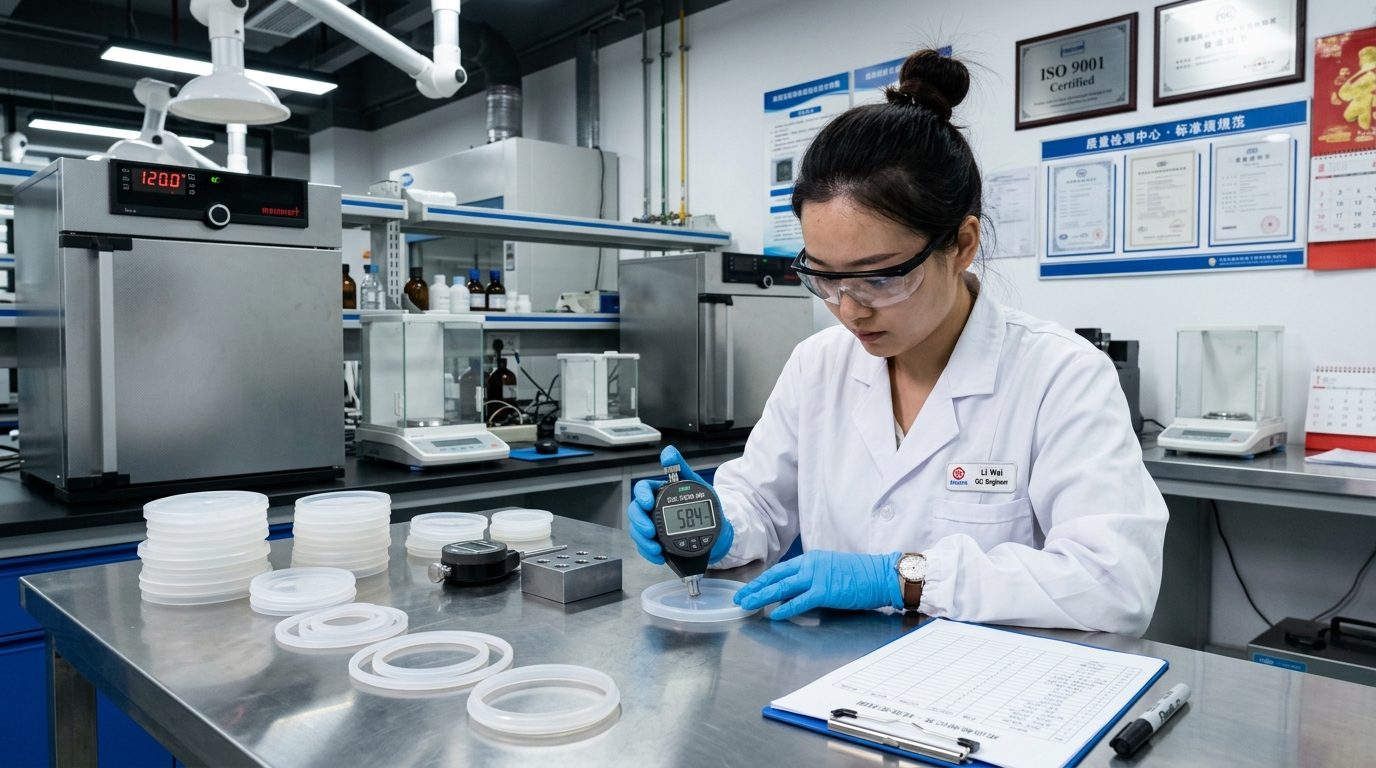
Figure 1.0: Quality engineer measuring Shore A durometer hardness and tensile elongation of molded food-grade silicone lids at Naike Gifts Jinjiang Testing Lab.
When sourcing silicone components—collapsible travel cups, leakproof tumbler seals, straw tips, or food container sleeves—curing chemistry and post-baking dictate chemical safety and retail compliance:
- Curing System Selection: Specify Platinum-Cured (Addition-Cure) Silicone for all European Union (LFGB § 30/31) and Japanese market destinations. It leaves zero acid residue, emits no chemical odor, and guarantees Volatile Organic Matter (VOM) < 0.5% w/w. Peroxide-Cured Silicone is 18%–25% cheaper and compliant with US FDA 21 CFR 177.2600, but has slight odor and fails German LFGB migration limits.
- Post-Curing Protocol: 100% of food-contact silicone must undergo secondary post-baking in a forced-air circulating oven at 200°C for 4 continuous hours to evaporate oligomeric cyclic siloxanes (D4, D5, D6).
- Durometer Hardness (Shore A): Specify 40A–50A for compression sealing gaskets; 60A–65A for push-on tumbler lids; 70A–80A for rigid structural protective boots and collapsible body hinges.
- Thermal Envelope: Continuous operational limits span -40°C to +220°C, completely safe for microwave reheating, boiling water sterilization, and industrial dishwasher cycles.
While silicone is universally marketed as "eco-friendly and food-safe," over 65% of customs detentions and consumer Amazon complaints regarding silicone drinkware stem from two root causes: acidic odor from low-grade peroxide curing agents, or high volatile organic migration from skipped post-baking cycles. Below is our factory testing manual for OEM/ODM buyers.
1.0 Platinum-Cured vs Peroxide Silicone: Chemical Comparison Matrix
Silicone rubber cross-linking chemistry determines optical transparency, residual odor, tensile rebound, and international regulatory clearance:
| Specification Parameter | Platinum-Cured Silicone (LSR / HCR) | Peroxide-Cured Silicone (Standard HCR) | Target Market Requirement |
|---|---|---|---|
| Catalyst Chemistry | Organo-platinum addition reaction (no by-products) | Dichlorobenzoyl peroxide free radical crosslinking | EU LFGB requires addition cure |
| Volatile Organic Matter (VOM) | < 0.35% w/w (Fully compliant with LFGB) | 0.8%–1.8% w/w (Exceeds German limits) | German LFGB limit: max 0.5% |
| Odor & Taste Transfer | Completely neutral; zero sensory transfer | Noticeable pungent organic acid odor if unbaked | Sensory test score > 2.5 fails in Germany |
| Clarity & Non-Yellowing | Crystal clear; 1000hr UV non-yellowing | Translucent/cloudy; susceptible to yellowing | Premium retail drinkware lids |
| Raw Material Cost Index | 1.30x–1.45x | 1.00x (Baseline) | Cost vs compliance trade-off |
| Regulatory Clearance | FDA 21 CFR 177.2600 + EU LFGB § 30/31 + BfR XV | FDA 21 CFR 177.2600 Only | Global multi-region retail programs |
2.0 Shore A Durometer Hardness Selection Guide (40A to 80A)
Silicone firmness is measured on the Shore A scale. Specifying the incorrect durometer results in leaking gaskets (too hard to seat) or flimsy lids (too soft to maintain seal under pressure):
Durometer Specification Guidelines
- 30A – 40A (Ultra-Soft Elastomer): Ideal for collapsible silicone cups, squeeze sauce nozzles, and soft straw mouthpieces. Highly flexible, but prone to tearing under sharp fingernail gouges.
- 45A – 55A (Standard Gasket Seal): The golden ratio for tumbler lid O-rings, vacuum container gaskets, and flip-cap plug seals. Delivers 25% compression deflection at standard hand-torquing (1.2 Nm).
- 60A – 65A (Semi-Rigid Lids & Sleeves): Used for snap-fit travel coffee tumbler lids, reusable food can stretch covers, and textured non-slip grip sleeves. Holds its form when handled while maintaining elastic snap.
- 70A – 80A (Structural Protective Hardware): Used for protective drop-impact boots on stainless steel bottles, weighted base rings, and internal structural valves. Resists permanent deformation and creep.
3.0 The Critical Post-Curing Protocol: 4 Hours at 200°C
During initial high-temperature mold pressing (165°C–180°C for 3–5 minutes), roughly 95% of cross-linking completes, but trace volatile siloxanes (D4–D20 cyclic oligomers) remain trapped inside the polymer matrix. At Naike Gifts, all food-contact silicone undergoes mandatory secondary post-curing:
- Post-Curing Equipment: Industrial stainless-steel cleanroom ovens equipped with continuous HEPA-filtered forced air circulation and negative-pressure exhaust scrubbers.
- Thermal Profile: Maintained at 200°C (±3°C) for 4 continuous hours.
- Physical Transformation: Post-curing evaporates 99.8% of residual volatile solvents, completely eliminates rubber odor, increases tensile rebound by 15%, and lowers compression set below 18%.
- Lab Verification: Every post-cured batch is tested for weight-loss volatilization according to LFGB § 30/31 protocols before packaging approval.
4.0 Mechanical Durability Benchmarks: Tensile & Tear Strength (ASTM D412)
Silicone components must survive repetitive stretching and aggressive retail dishwasher sanitization:
| Physical Mechanical Test | Standard Method | Target Benchmark | Failure Risk in Field |
|---|---|---|---|
| Tensile Strength | ASTM D412 (Dumbbell Die C) | ≥ 8.5 MPa | Ripping during container lid removal |
| Elongation at Break | ASTM D412 | ≥ 450% | Snapping when stretched over bottle rims |
| Tear Strength (Crescent) | ASTM D624 (Die B) | ≥ 28 kN/m | Crack propagation starting from straw slit |
| Compression Set (22hr @ 70°C) | ASTM D395 (Method B) | ≤ 20% | Permanent seal flattening causing liquid leaks |
5.0 Liquid Silicone Rubber (LSR) vs Solid Compression Molding Economics
Depending on order volume and geometry complexity, we utilize two distinct molding technologies:
- Liquid Silicone Injection Molding (LSR): Uses two-component liquid silicone (Part A + B) mixed under 100-bar precision servo pressure and injected into cooled runner, heated cavity tooling. Cycle time: 25–45 seconds. Flash-free, zero burrs, medical-grade dimensional repeatability (±0.05mm). Recommended for orders > 20,000 units.
- High-Consistency Rubber (HCR) Compression Molding: Pre-weighed solid silicone blanks are hand-placed into multi-cavity heated steel compression dies. Tooling cost is 60% lower than LSR ($1,500–$3,500). Flash requires manual cryogenic de-flashing. Ideal for initial pilot orders of 1,000 to 10,000 units.
Need Custom Silicone Parts Engineered & Tested?
Provide your 3D CAD step files or color references. We supply custom Pantoned silicone prototypes, Shore A durometer swatches, and SGS LFGB test reports within 5 business days.
Food-Grade Silicone Sourcing & Compliance FAQ
Can custom silicone lids be Pantone color-matched?
Yes. We color-match to coated and uncoated Pantone guides using inorganic, FDA/LFGB-certified liquid silicone color masterbatches. Translucent, pastel, neon, and glow-in-the-dark effects are available with zero heavy metals.
How can a buyer verify if silicone was properly post-cured?
Conduct a simple field test: submerge the silicone part in freshly boiled water (100°C) inside a sealed glass jar for 15 minutes. Upon opening, an un-baked or peroxide-cured part will emit a noticeable sharp acidic odor. A properly post-cured platinum part produces zero smell and zero oil sheen on the water surface.
What is the lead time for custom silicone compression vs LSR tooling?
Solid compression tooling takes 10 to 14 business days with first-article samples delivered in 3 days thereafter. Precision multi-cavity LSR cold-deck injection molds require 20 to 25 business days for precision EDM machining and valve-gate balancing.
Food-Grade Silicone Misconceptions Debunked
❌ Myth 1: "The 'Pinch Test' (Checking for White Marks) Proves Silicone Quality"
✔ Engineering Reality: The internet 'pinch test' is a myth. White marks upon flexing merely indicate pigment dispersion or mineral filler levels. True food-grade compliance is verified through gas chromatography mass spectrometry (GC-MS) testing for volatile organic matter (VOM < 0.5% for LFGB) and platinum vs peroxide catalyst residue verification.
❌ Myth 2: "All Food-Grade Silicone is Inherently Odorless Straight from the Press"
✔ Engineering Reality: Freshly compression-molded silicone contains residual cross-linking cyclosiloxanes. High-grade food silicone requires mandatory secondary post-curing in forced-air industrial ovens at 200°C for 4 continuous hours to completely evaporate volatile residues.
❌ Myth 3: "Silicone Has Indefinite Resistance to Commercial Dishwasher Chemicals"
✔ Engineering Reality: While silicone handles 220°C heat, prolonged exposure to highly alkaline industrial dishwashing detergents (pH > 11) can cause surface tackiness and mineral deposit staining. Platinum-cured liquid silicone rubber (LSR) provides 3x greater chemical durability compared to standard solid silicone.