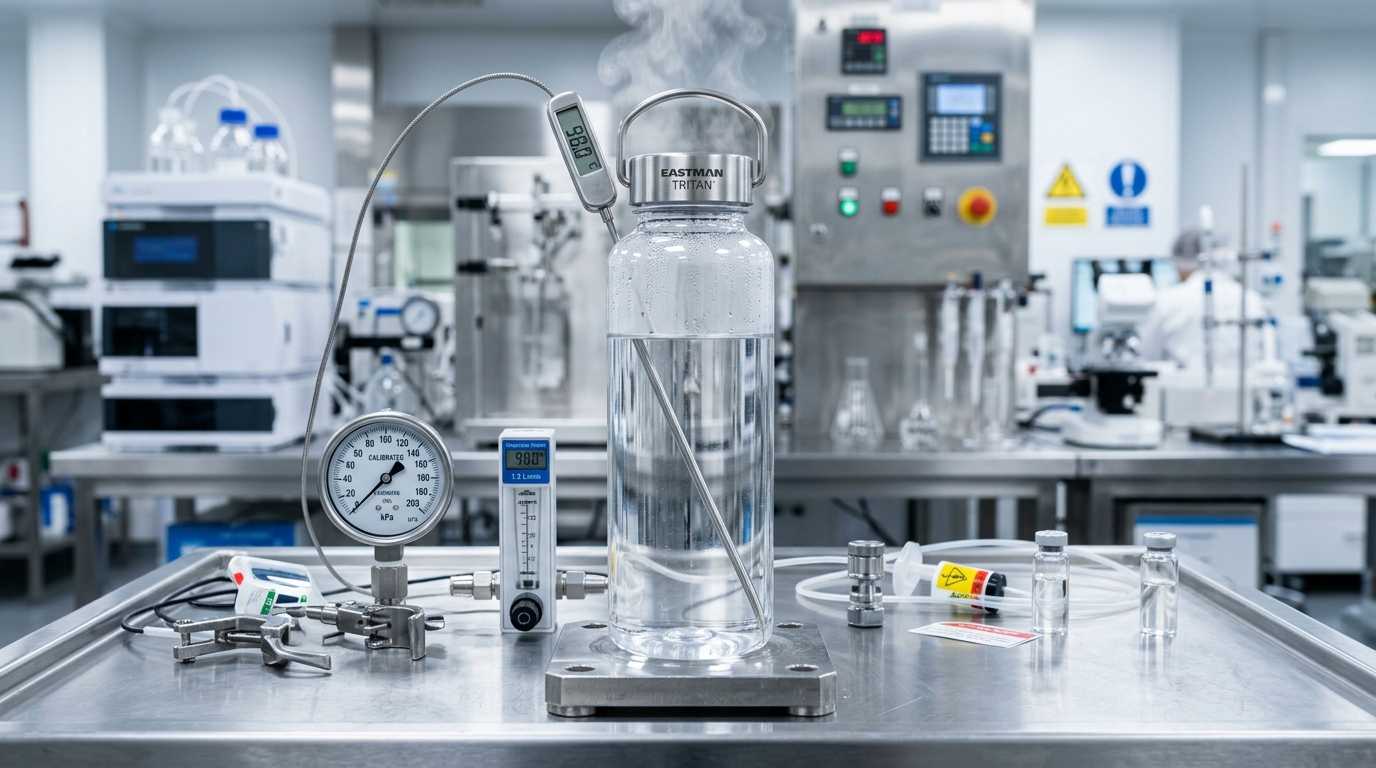
Figure 1.0: Optical transmission (ASTM D1003) and 100°C thermal shock verification on Eastman Tritan™ TX1001 tumblers at Naike Gifts Jinjiang Testing Center.
Yes. Eastman Tritan™ copolyester is recognized worldwide as one of the safest food-contact polymers for hot water, cold beverages, and commercial dishwashers when molded from 100% virgin resin under controlled temperature parameters.
- 100% Free of Bisphenols & Endocrine Disruptors: Completely free of BPA, BPS, BPF, phthalates, and estrogenic/androgenic activity (EA/AA-Free).
- High Thermal Deflection: Continuous operating temperature of -20°C to 100°C (-4°F to 212°F). Safe for freshly boiled hot tea, coffee, and soup.
- Commercial Dishwasher Tested: Certified for 100+ commercial wash cycles (>65°C wash + 85°C hot air dry) without clouding, micro-cracking, or warping.
- Extreme Shatter Resistance: Izod notched impact strength of >850 J/m, surviving repeated 1.2m–1.5m drops onto concrete without cracking.
📌 Regulatory Compliance: Meets U.S. FDA 21 CFR 177.1240, European Regulation (EU) No 10/2011, and German LFGB §30/31 overall migration limits (<10 mg/dm²).
For global consumer brands, corporate gift suppliers, and hospitality procurement directors, plastic food contact safety is no longer just a marketing buzzword—it is an existential compliance requirement. With strict EU GPSR customs scrutiny, California Prop 65 enforcement, and Amazon strict food-grade audits, specifying the exact grade of Eastman Tritan™ is critical. Below is our factory's comprehensive technical evaluation.
What Is Tritan Plastic Made Of? Polymer Chemistry
Eastman Tritan™ is a specialized copolyester developed by Eastman Chemical Company as a safe, drop-in replacement for traditional Polycarbonate (PC).
Conventional Polycarbonate relied on Bisphenol A (BPA) as a primary building block. Under thermal stress and detergent wash cycles, the ester bonds in PC break down (hydrolyze), releasing free BPA molecules into drinking liquids.
Molecular Architecture of Eastman Tritan™ (TX1001 / TX2001)
Tritan is synthesized through the polycondensation of three distinct monomers:
- Dimethyl terephthalate (DMT) – provides dimensional rigidity and baseline chemical resistance.
- 1,4-Cyclohexanedimethanol (CHDM) – delivers flexibility and broad processability.
- 2,2,4,4-Tetramethyl-1,3-cyclobutanediol (CBDO) – a sterically hindered cyclic diol that prevents crystallization, producing 90%+ clarity and exceptional hydrolytic resistance.
Because none of these precursor monomers contain a bisphenol phenolic core, Tritan is fundamentally incapable of decomposing into BPA, BPS, BPF, or other endocrine-disrupting chemicals.
Tritan vs PP vs Glass vs Stainless Steel: Comparison Matrix
To help product developers and purchasing managers choose the right material for their drinkware programs, our laboratory evaluated the four dominant food-contact materials across identical physical and economic metrics:
| Performance Metric | Eastman Tritan™ TX1001 | Food-Grade PP (#5) | Borosilicate Glass 3.3 | 304 Stainless Steel |
|---|---|---|---|---|
| Optical Clarity (%) | >90% (Glass-like crystal) | 60%–70% (Translucent/Milky) | 92% (Total Transparency) | 0% (Opaque Metallic) |
| Max Temperature Limit | 100°C (212°F) continuous | 120°C (248°F) continuous | 450°C (842°F) | 800°C+ |
| Thermal Shock Resistance | Excellent (Ice to Boiling) | Good (Tolerates boiling) | Moderate (ΔT ~ 150°C max) | Immune to thermal shock |
| Impact Durability (Drop Test) | 1.5m drop: 0% breakage | 1.5m drop: 0% breakage | 1.2m drop: 100% shattering | 1.5m drop: Denting only |
| Dishwasher Safe Cycles | 100+ cycles (Zero Haze) | 100+ cycles (Gloss loss) | 500+ cycles | 300+ cycles (Powder coat wear) |
| Microwave Safe? | No (Reheating restricted) | Yes (Safe up to 120°C) | Yes (Safe) | Strictly Prohibited |
| BPA / BPS / EA Free? | 100% Certified Free | 100% Certified Free | 100% Inert Mineral | 100% Metal Alloy |
| Piece Price Index (FOB) | $$$ (2.5x–3.0x vs PP) | $ (1.0x Base Economy) | $$$ (2.2x–2.8x) | $$$$ (3.5x–5.0x) |
Can Tritan Handle Boiling Water and Dishwashers?
The two most frequent inquiries we receive from retail brand clients are: "Will a Tritan tumbler warp when filled with boiling tea?" and "Does commercial dishwashing cause Tritan to crack at the base?"
1. 100°C Boiling Water Exposure Testing
At Naike Gifts testing facility, standard 750ml single-wall Tritan sports bottles were subjected to 100°C (212°F) boiling water filling protocols:
- Volumetric & Dimensional Shrinkage: Measured after 2 hours of boiling water soak: radial dimensional change was less than 0.11%, well within the ISO 20457 precision tolerance envelope (±0.25mm).
- Sensory & Odor Release: Conducted under DIN 10955 sensory testing guidelines; zero plastic taste or aromatic odor transferred to purified water.
- Handling Advice: Single-wall Tritan conducts heat efficiently. For boiling tea or coffee, we recommend designing protective silicone grip sleeves or specifying double-wall insulated structures to prevent hand discomfort.
2. 100-Cycle Commercial Dishwasher Hydrolysis Protocol
Consumer dishwashers expose drinkware to highly aggressive conditions: high temperatures (65°C–70°C), concentrated alkaline caustic detergents (pH 10.5–11.5), and intense 85°C dry cycles.
Factory Test Findings (Miele Professional G7856 Lab Washer):
- Haze Measurement (ASTM D1003): Virgin Tritan maintained optical haze below 0.85% after 100 consecutive commercial cycles. In contrast, standard AS (SAN) developed visible milky haze (>5.2%) after just 25 cycles.
- Environmental Stress Cracking (ESC): Zero micro-fissures or spiderweb crazing along high-stress injection gates and closure threads.
- Critical Tooling Requirement: To guarantee dishwasher longevity, the injection mold must utilize hot runner systems with mold temperatures strictly maintained at 60°C–70°C. This ensures complete relaxation of polymer orientation chains during molding.
Common Industry Misconceptions Debunked
❌ Misconception 1: "Tritan is Just a Trade Name for Polycarbonate"
✔ Technical Reality: Polycarbonate (PC) is a resin made from bisphenol A and phosgene, classified under recycling code #7. Tritan is an entirely distinct copolyester resin family with an entirely different chemical CAS registry (CAS No. 1038844-12-8). It contains zero BPA and zero chemical precursors related to diphenylmethane structures.
❌ Misconception 2: "If It Can Hold 100°C Water, It Is Safe to Microwave"
✔ Technical Reality: While Tritan withstands uniform 100°C water, microwave radiation interacts unevenly with fatty oils, broths, and concentrated sugars. These food components can create superheated hot spots reaching 140°C–160°C within seconds, causing localized resin melting and irreversible surface blistering. For microwave containers, Polypropylene (PP #5) is the correct engineering choice.
❌ Misconception 3: "All Clear Water Bottles on Alibaba are Genuine Tritan"
✔ Technical Reality: Raw Eastman Tritan resin costs approximately $3,800–$4,400 USD per metric ton, compared to just $1,400 for standard AS and $1,100 for PET. Many low-cost suppliers secretly blend PET, PCTG, or AS scrap regrind into their melt hopper to lower production costs. Buyers must insist on authentic resin lot traceability and raw resin import customs declarations.
B2B Buyer Sourcing & Compliance Checklist
Before placing commercial OEM production orders for custom Tritan drinkware, international buyers should require their supplier to verify the following five technical milestones:
Procurement & Quality Verification Checklist
- 1. Genuine Eastman Resin Invoices & CoA: Request batch-specific Certificate of Analysis (CoA) identifying the exact resin grade (e.g., Tritan TX1001 for injection, TX2001 for heavy-wall tumblers, or EX401 for infant care).
- 2. Finished SKU Migration Testing: Testing must be performed on the final molded SKU (including custom Pantone color masterbatch and surface UV coatings), not merely raw resin pellets. Must satisfy EU 10/2011 Overall Migration (<10 mg/dm²) in 10% ethanol, 3% acetic acid, and rectified olive oil.
- 3. Mechanical Drop Verification: Require a pass certificate for 1.2m drop tests onto concrete at 100% capacity (water at 20°C and cold water at 4°C) under ANSI/ASQ Z1.4 Level II sampling plans.
- 4. Cap Seal Vacuum Testing: Bottles with flip-top or straw lids must undergo negative pressure leak testing (-0.05 MPa underwater vacuum hold for 30 seconds) to verify zero air bubble leakage.
- 5. Factory DFM Review: Verify that the injection mold features uniform wall thickness transitions (>1.8mm) and polished radius corners (>R0.8mm) to eliminate notch-sensitive stress fracture points.
Looking for Certified Tritan Drinkware Manufacturing?
Naike Gifts operates 40+ precision injection molding lines with 100% virgin Eastman Tritan™ resin traceability and complete FDA/LFGB laboratory testing support.
Frequently Asked Questions (FAQ)
Can I put boiling water (100°C / 212°F) into a Tritan water bottle?
Yes. Genuine Eastman Tritan™ copolyester (such as grades TX1001 and TX2001) has a continuous thermal deflection rating between 99°C and 108°C. Boiling water can be poured into Tritan tumblers without warping or harmful chemical leaching. However, ensure the bottle has an active steam pressure relief vent before screwing the lid shut to avoid hot liquid spray.
Is Tritan truly 100% free of BPA, BPS, and estrogenic activity?
Yes. Tritan is synthesized from dimethyl terephthalate, 2,2,4,4-tetramethyl-1,3-cyclobutanediol, and 1,4-cyclohexanedimethanol. It does not utilize Bisphenol A (BPA), Bisphenol S (BPS), or any orthophthalate plasticizers. Independent GC-MS and in-vitro testing confirm zero detectable estrogenic activity (EA) and androgenic activity (AA).
Why do some cheaper Tritan cups develop crazing or cloudiness in the dishwasher?
Cloudiness or hairline stress crazing is almost always caused by improper injection molding parameters (high residual internal molded-in stress) or counterfeit copolyester blending. At Naike Gifts, all Tritan parts are molded on precision servo-electric presses with automated desiccant dehumidification and mold temperatures maintained at 60°C–70°C to eliminate residual stress.
Can Tritan drinkware be heated in a microwave?
Microwaving Tritan drinkware is generally not recommended. While the polymer itself does not absorb microwave energy, localized hot spots from oily residues, dairy, or concentrated sugars can easily exceed 120°C–140°C, causing localized melting or deformation. For microwave heating, food-grade Polypropylene (PP #5) is the industry standard.